On 14th April, we hosted a live webinar titled “The AI Disruption Survival Guide for Software Firms” The webinar was presented by Marcin Majewski, Managing Director, and Filip Drazdou, M&A Director at Aventis Advisors.
You can now watch the full webinar replay below. If you would like to download the presentation material used during the session, you can easily do so by clicking the download report button on the left (if you are using a computer) or by scrolling at the very end (if you’re using a phone).
Marcin Majewski:
Hello, everyone, and welcome to our webinar. One thing we can all agree on right now is change, and the pace of that change is accelerating. Unlike our typical webinars, where we discuss valuations and M&A trends, we wanted to shift the theme a little and talk about how to best adapt to what is happening and what the ideal position to be in looks like.
We don’t have a single thesis that fits everyone, but we have tried to build a framework you can take and apply to your business or investments and see what works for you. We talk to a lot of founders and investors every day, and we try to identify what works and generalize it.
That is how we came up with our ADAPT framework. I’m Marcin Majewski, founder of Aventis Advisors, and I’m here with Filip.
Marcin Majewski:
We’ll walk you through the ADAPT framework. But first, a few words on why we thought it was important to talk about this and diverge a little from our usual themes. These are special times, we feel it, we see it in everyday life. We see opportunities everywhere, and we also see that if you don’t move fast, someone else will take them. We’d rather that someone be you, our followers, readers, and newsletter subscribers.
When we look at change through the lens of evolution and Darwin’s theory of survival of the fittest, we believe the key prerequisite for survival right now is adaptability, hence the ADAPT framework. There are many good reasons to become more adaptive: you are more likely to be better off financially, and it also helps reduce stress, improve health, and increase overall enjoyment of life. So on multiple levels, these principles are worth applying. Let’s dive in.
One thing I should mention before we start: while our focus is on software firms, this framework is equally relevant to any business. Software companies simply appear to be the most exposed right now, because the technologies currently available are most suited to creating software. That said, it is just the tip of the iceberg, in two years’ time, builders, lab professionals, and engineers of all kinds may face the same pressures.
What we have been seeing in valuations is widespread consensus that growth in software either won’t materialize, will take longer, or at worst won’t meet expectations, and this is reflected in valuations.
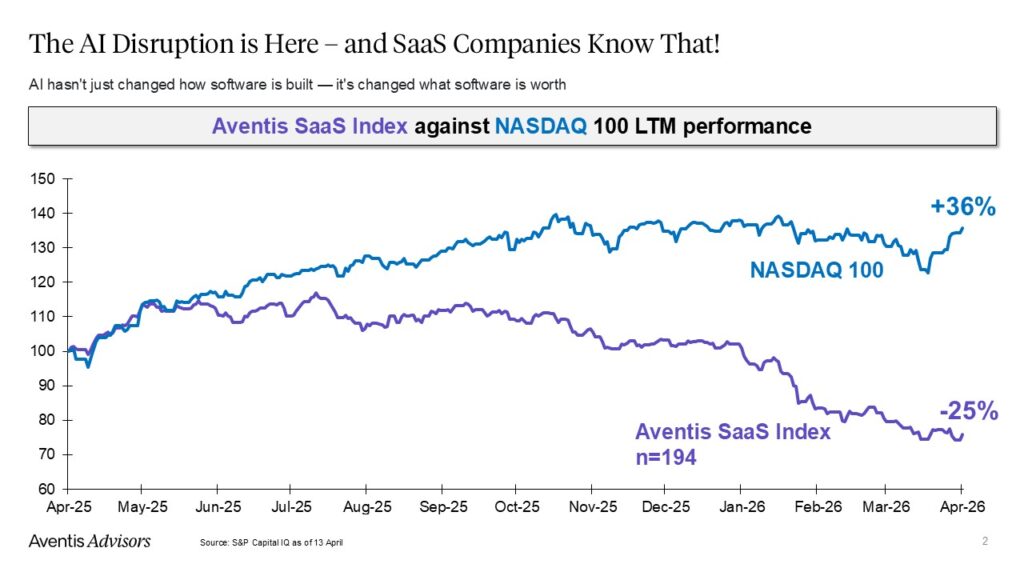
Over the last 12 months, our curated SaaS index diverged significantly from the broader tech sector. NASDAQ dropped 36%, while software fell 25% relative to it, a gap of around 50%. That’s quite spectacular, and it shows the power of these new technologies. Should you write off SaaS companies entirely? That’s exactly why we’re having this conversation, so that you are not the one written off. We firmly believe there is potential, and that any company can adapt and ride this wave of innovation.
Filip Drazdou:
At the same time as traditional software companies are losing value, an equally large number of new companies are emerging and growing revenue very rapidly. You can see companies now going from zero to $10 million or $100 million in a fraction of the time it used to take.
What the data reflects among more mature companies is that they may not be adapting as quickly as they should, while a whole new wave of companies is capturing market share and growing in value. Whether you have a smaller company or an established business, it comes down to adaptation.
At Aventis, we’re adapting ourselves every day. We’re not just in the software business, we have to be in the tech and AI business. We can see how significant that shift is. Even in this webinar, we’re moving away from simply presenting revenue multiples to something more nuanced, because that model no longer works on its own.
You can’t just slap a multiple on revenue and call it a valuation for a software business. You need to think deeply about AI. At the same time, winners can become losers quickly, and competition can emerge from a single new release by a large company. It’s an exciting time, but also a very dangerous one, and we want to help you frame your thinking and make better decisions for your business or investments.
Marcin Majewski:
Let’s unfold what we mean by the ADAPT framework, going through it one step at a time.
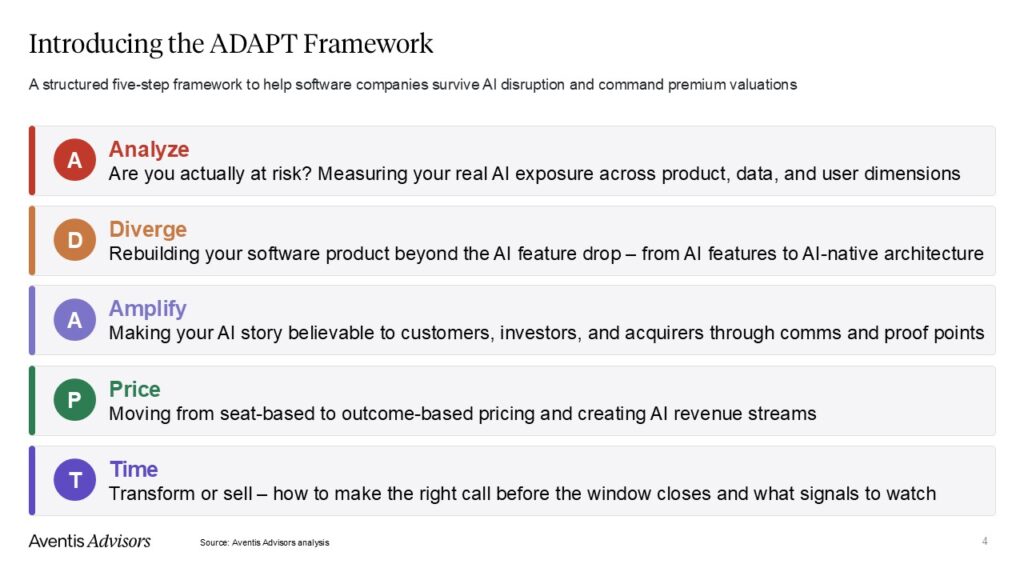
The first step to successful adaptation is to Analyze your environment and understand what is happening. Every business is at risk, but you need to honestly assess how exposed you are, what you can build on, and how to defend yourself. If your position isn’t defensible, you need to understand what your options are. We’ll walk you through how to analyze your situation and what to focus on to get to a clear answer.
The second point is that you need to Diverge. In a world where code is becoming a commodity, essentially a utility available on demand, there has to be another way to differentiate yourself. You can’t just copy features or keep building more of the same. You have to build something different. The best way to do that is to understand your customers better and serve their specific needs more effectively.
Third is to Amplify. You cannot go it alone. You need a team and external support. That means setting a clear internal vision, changing how people work, selling your direction to customers, raising money, or even selling the business. In all cases, you need to get your message across, that’s why we use the word amplifying, in the sense of communication.
The fourth point is Price, or more precisely, how you deliver value. As business models change, you can no longer rely on the same pricing approach. We’ll discuss how pricing in software and AI is evolving into something we haven’t seen before in the technology space.
And lastly, Time. We all live on some kind of timeline, businesses, investors, professional careers, retirement, succession. Everyone has a timeline, and we want to help you make the right call: whether it’s time to sell, time to grow, or time to optimize for cash flow.
Analyze
Filip Drazdou:
The first step is really about starting to think through the risk AI poses to your business. In our experience, that risk is usually larger than most people assume, simply because we can’t predict what comes next. We’ve all seen this play out over the past couple of years: when ChatGPT first launched, the general reaction was that it could write some text but wasn’t great, and then a year later, it was very good. The same pattern happened with coding. Some of the risks that matter most are the ones we don’t yet know about.
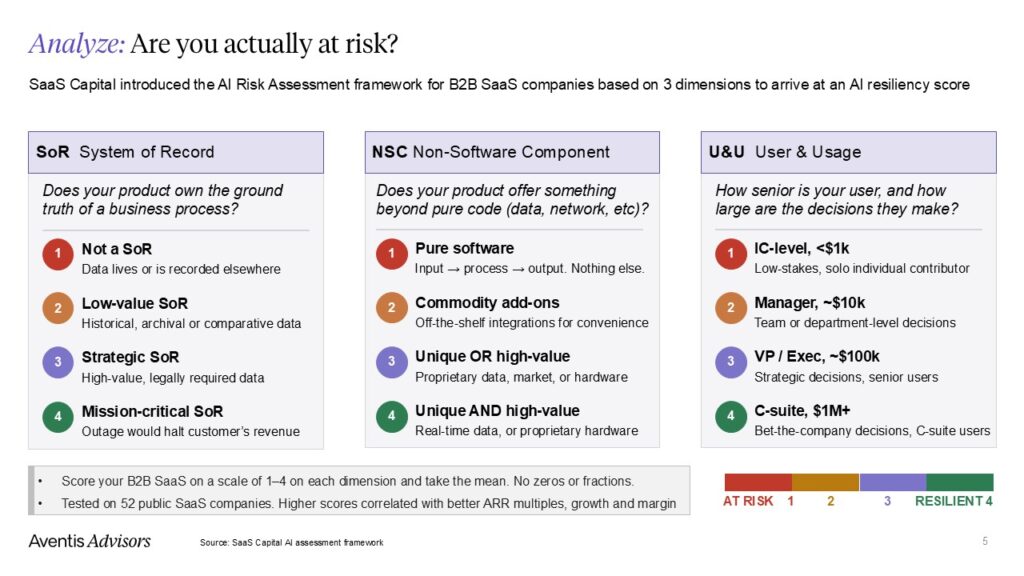
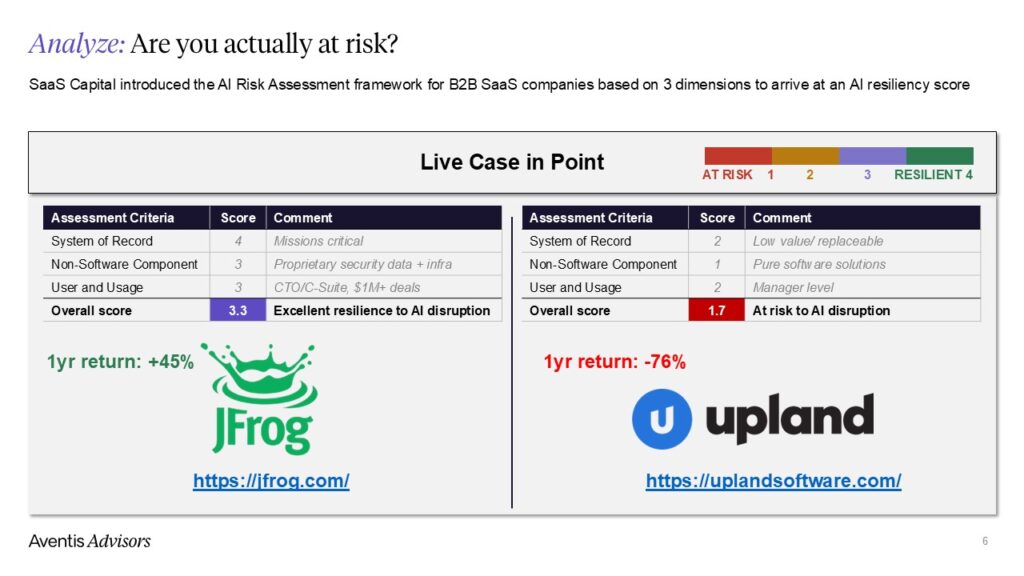
To assess this, we use a framework originally developed by SaaS Capital, which evaluates companies on AI risk across three dimensions.
The first is system of record. When thinking about which software types will be replaced by AI first, the most vulnerable are those that don’t store meaningful data and aren’t mission-critical. For example, a tool that takes data from one place, transforms it, and outputs it somewhere else, if you cut it off or automate that process with AI, the software becomes unnecessary.
This is very different from a strategic, mission-critical system of record, like an advanced ERP or accounting software where all financial transactions are stored and legally required. The key question founders need to ask is: does this product know the ground truth of a business process?
Or, more practically, what would happen if the software suddenly stopped working? If the answer is that business operations would halt, like with manufacturing automation or point-of-sale systems, it is mission-critical. If it’s primarily a marketing tool, it may be important to a marketing agency but far less critical overall.
The second dimension is the non-software component. In the past, everyone valued pure SaaS revenue most highly. Now we’re seeing that additional revenue streams, services, data resale, anything beyond pure code, are becoming more valuable, especially in combination. Pure software that simply takes input, processes it, and produces output can be substituted quite quickly because there is nothing proprietary in that.
But if you have proprietary data, algorithms, or workflows, something that AI doesn’t have access to and can’t replicate because it lacks vertical-specific knowledge, then your position becomes much more defensible. For example, custom, proprietary datasets that only you collect would make a meaningful difference.
The third dimension is user and usage. How senior is your user? How significant are the decisions they’re making? If a CEO logs into your product daily to review performance or make million-dollar decisions, that use case is less likely to be replaced by AI. In contrast, a tool used by individual contributors for lower-stakes tasks can easily be swapped out, today they’re using your software, tomorrow they’re experimenting with an AI tool, and the day after, a new AI-native company has emerged.
This dimension also captures organizational inertia: if your product is used by C-suite executives at large corporations, it will naturally take longer for AI to disrupt it, due to bureaucratic processes, long approval cycles, and regulatory requirements.
When you analyze your company across these three dimensions, you average the scores on a scale of 1 to 4 to assess whether you’re at risk or resilient. I’d strongly encourage doing this without the help of AI, because AI tends to be optimistic and will likely tell you that you’re not going to be disrupted. An honest, unvarnished assessment is the starting point. In our experience, most companies, especially those focused on small businesses or operating in the marketing and sales space, will land at around 1 or 2. Scores of 3 or 4 are typically reserved for complex enterprise software.
Marcin Majewski:
It would be worth illustrating this with some real examples.
Filip Drazdou:
The two examples we use are JFrog and Appland Software. JFrog is a supply chain software company serving software businesses, essentially a central warehouse for all your software tools, MCPs, and related assets.
They benefit from AI adoption; if anything, they become more important as automation and AI proliferate. They’re a complex company to understand if you don’t have a technical background, and that complexity actually works in their favor. They are a necessary part of this modernization wave.
Upland Software, on the other hand, also operates in software tooling, but at a much smaller and more granular level, individual pieces of code and libraries. These are exactly the kinds of things that large language models have been trained on, and they’re not mission-critical for operations, don’t carry significant non-software components, and are used at the individual developer level.
A developer who previously needed to look up a library or piece of code to implement can now simply ask AI to generate it. This makes Appland highly exposed, and we can see this clearly in the annual returns of both companies.
Marcin Majewski:
What’s particularly interesting here is that both companies serve the same target market: software developers. The same macro trends affect both, yet the impact on their businesses is completely different. One is largely replaceable, while the other is becoming more entrenched and prominent. There is hope, but you really need to be honest about where you stand and how to move your organization along these three dimensions toward a more defensible position. Once you have a clear picture of reality, you can move forward to building something new.
Diverge
Marcin Majewski:
Once you know where you stand, you can move on to building something new. We have three ideas for how to diverge rather than getting stuck competing with everyone, including companies like Anthropic, which is moving so fast that it can deliver almost anything these days. It may not yet be fully scalable or secure, but it’s only a matter of time before they crack those challenges too.
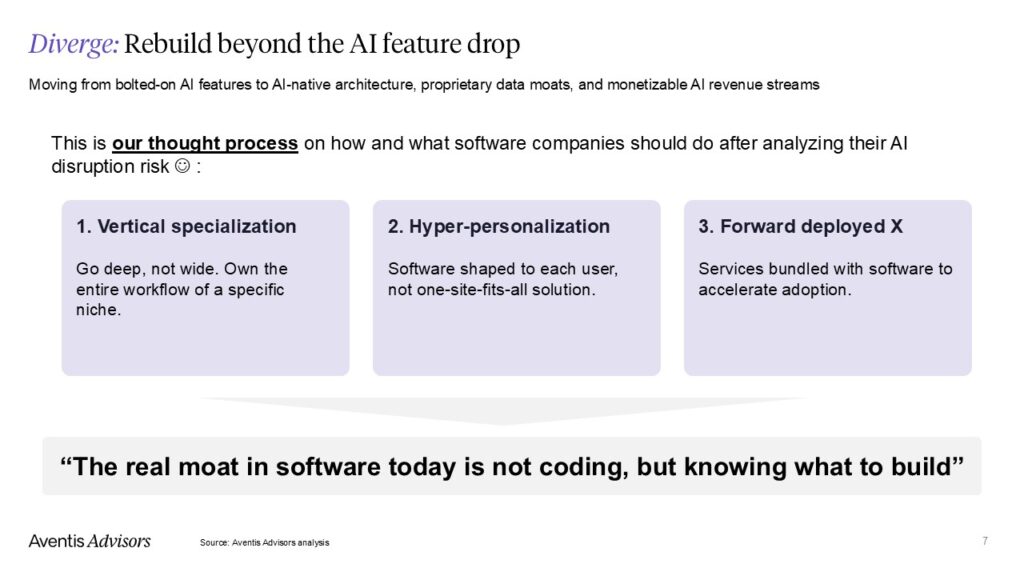
The first strategy is to specialize. In a world where code is becoming a commodity, the response is to go deep: understand the specific niche your clients operate in and solve their particular problems in ways that generic, one-size-fits-all tools cannot. Once you build that intimacy, once you’ve solved someone’s real pain points and they’ve integrated your product into their workflows, they are far less likely to leave. This has long been, and remains, the most reliable way to build sustainable software products.
Filip Drazdou:
We’re also seeing on the market that interest in vertical software remains strong. There are many buyers and roll-ups whose thesis around vertical software is largely unchanged, they still believe in it. If you’re thinking about an exit or M&A, this segment of the software market has been least affected by the stock market changes and investor sentiment shifts we’ve seen elsewhere.
Marcin Majewski:
We haven’t seen any meaningful repricing in this space, which is encouraging for anyone already operating there.
The second approach is hyper-personalization, which is really about transforming your product into something AI-native. Rather than presenting users with a fixed dashboard, table, or rigid workflow, you build interfaces that are more custom, more natural, and powered by natural language. The goal is software that adapts to how people actually think and work, rather than forcing them to adapt to the software. If ChatGPT can know a user better than their own family, your software should be able to as well. That’s the direction software needs to move toward.
Filip Drazdou:
With how easy it has become to generate UI, the standalone value of interface design is declining. But what we can envision is a future where the underlying database is the same for all users of a CRM, but one person works with a Kanban board, another interacts via a chatbot, and a third views a simple table, everyone engaging with the same data in the way that suits them best.
Marcin Majewski:
The third approach was inspired by Palantir’s concept of forward deployed engineers. The idea is that consultants or engineers work closely within client teams to build solutions tailored to the organizations they serve.
We believe this approach can be replicated more broadly. For example, a marketing software company could embed itself with a marketing agency to gain deeper customer intimacy, tighter lock-in, and become the go-to partner for everything AI-related. This is a powerful way to improve defensibility, and we’re already seeing companies act on this thinking.
In fact, something we hadn’t observed before: software companies actively looking to acquire IT services or professional services firms to build deeper customer integration and extend client relationships.
The broader point is that AI cannot decide what to build. It can generate code, but it can’t have the human skill of going out, talking to people, understanding their pain points, and figuring out what’s actually worth solving. That judgment remains with founders and business owners, and it’s one thing AI won’t replicate well for quite some time.
Filip Drazdou:
These three approaches, specialization, hyper-personalization, and forward deployment, all point in the same direction: going deep with your customers, bringing your expertise to them, and helping them succeed.
Amplify
Filip Drazdou:
When it comes to amplification, the first dimension is external. There is an element of necessity here: you really have to position yourself as AI-first, because everyone else is. It didn’t take us long to find screenshots showing that virtually every major software company now presents itself as an AI company. The marketing tends to move faster than the underlying product, and that is fine, but if your competitor is positioning as AI-first and you are not, that’s a problem, regardless of where things actually stand under the hood.

Marcin Majewski:
On the internal side, we spotted the winds of change a few years ago. As a founder, I realized we had to adapt, and I’ve been pushing our AI agenda for around three years now, despite some internal skepticism. This kind of change starts with the founder or board making a clear decision and committing to an AI journey. It’s not mandatory, not every company needs to change, but it is very unlikely that companies that choose not to will survive in the long run.
As leadership, you need to focus on bringing your team along, building a roadmap and vision for where AI is taking you, and tracking progress. Measuring what matters is how you coalesce your organization around building a new technology stack. There will be resistance, and we understand it, continuing as is remains a technically viable choice, but you need to understand the trade-offs clearly.
Once you have internal alignment, you can build on it externally. You have to communicate your AI direction, because today, if you don’t emphasize AI in your messaging, you sound out of step, even if the underlying work is still in progress.
Beyond marketing, it matters for talent recruitment and fundraising. And if you’re considering raising capital or selling a business, it’s critically important to track and report AI revenue separately from the rest. If you cannot distinguish AI from non-AI revenue, it becomes very difficult to demonstrate the success of your AI strategy to investors or acquirers.
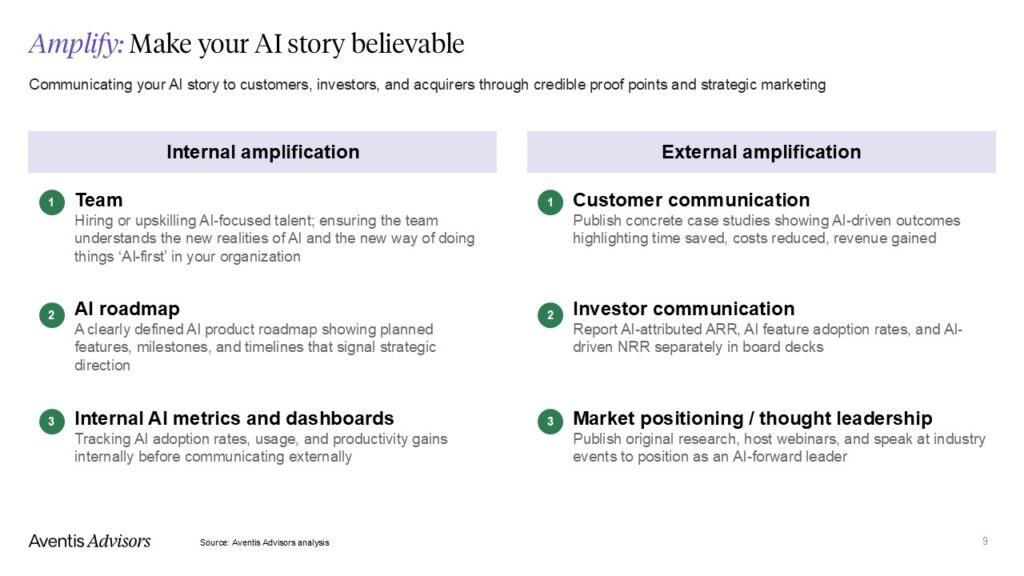
Finally, the AI space is still relatively small and interconnected. Sharing your insights and achievements openly is genuinely valuable, we’ve seen companies go from zero to a million dollars or more almost entirely through social media, by building something original and sharing it freely.
Becoming part of the thought leadership community in this space is a great way to attract talent, capital, and attention. It’s a different world where information is freely shared, and those who structure and contribute that information add real value.
Filip Drazdou:
For internal amplification specifically, what we see is that the largest and most bureaucratic organizations are the ones pushing AI adoption hardest, Meta has a token usage leaderboard, and some consultancies track how frequently their people log in to Claude. If the largest organizations are going to these lengths, there’s little excuse for not pushing AI adoption in a smaller, more agile company.
Price
Filip Drazdou:
We believe pricing is where one of the biggest transformations in software business models is going to happen. That said, pricing has always evolved, it is nothing new. Looking back to around 2000, software was sold as a perpetual license on a CD, with new versions purchased every year or two and installed locally. Salesforce then pioneered cloud subscription pricing, and the whole SaaS subscription ecosystem developed from there.
Adobe’s shift to cloud around 2012 introduced tiered pricing, and over time the model was refined with premium tiers, multi-year deals, volume discounts, and so on, an entire industry developed around optimizing SaaS pricing.
What we’re seeing now with AI is a shift toward a hybrid model. Most AI companies still offer subscriptions, because it has been such a powerful model and the entire software industry is conditioned to think in terms of recurring revenue, upsell, downsell, churn, and the like. But we see a gradual move toward usage-based pricing.
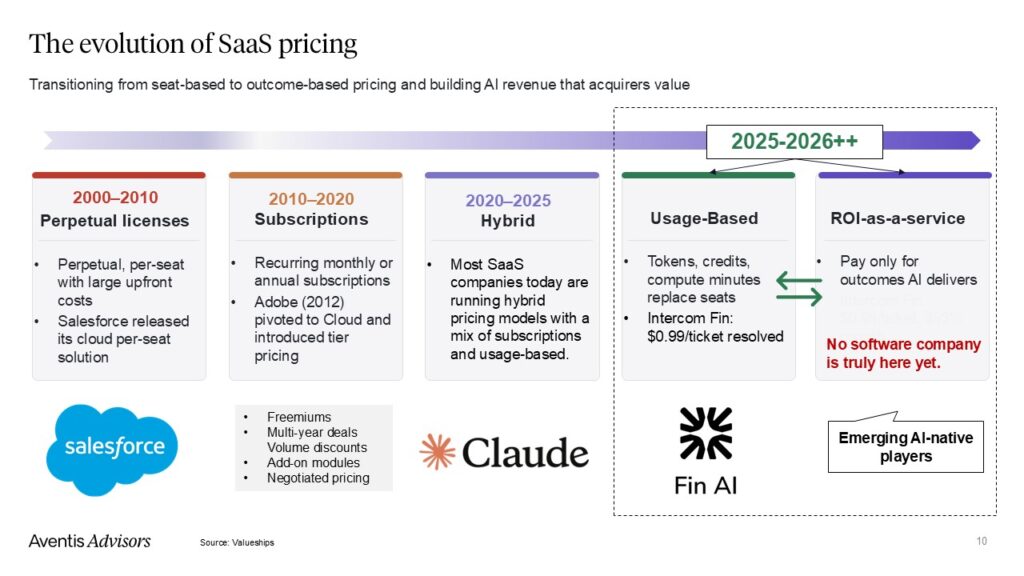
Today you might pay $20 per month for ChatGPT or Claude, with additional usage-based charges on top for API calls and extra compute. And in an agentic world, where data flows through MCP connections and AI can perform operations directly within software, per-seat pricing starts to make less sense, because a single account with the right automations can do what previously required many users.
The direction is clearly toward paying for tokens, credits, minutes, or compute, something that correlates directly with actual usage rather than number of seats.
We’re already seeing early signals of this: ServiceNow, for example, has introduced limits on how much AI can interact with data inside its software. This transition will likely take time, similar to how long it took to move from perpetual licenses to subscriptions, but that is clearly where the industry is heading.
Marcin Majewski:
What is happening now resembles the earlier transition from on-premise perpetual licenses to cloud subscriptions. It will take time and may be painful at first, especially since tokens are currently being subsidized by the major AI companies, which makes it hard to compete in that space directly.
But if you follow the ADAPT framework, particularly the Diverge section, you will find a way to be fairly compensated for the value you provide. What’s more, you may find yourself targeting a completely different budget line.
If you solve a specific business problem, say, customer care, you’re no longer just competing for a slice of the IT software budget. You’re potentially targeting the payroll budget for that department. If your solution allows a client to operate with fewer people, they can shift part of that payroll spend to your product or service. That opens up a much larger addressable market.
We are genuinely optimistic about the sector as a whole. Technology has always emerged as a winner from periods of change. The question is just who the winners will be, there are too many moving parts right now to predict with certainty.
It could be that one or two major AI companies dominate across industries, or it could be hundreds of specialized players, or it could be that AI intelligence becomes a utility underpinning a world of nimble, specialized software and IT services companies. What we do know is that the pie is going to grow, and more of it will accrue to those who deliver the most value.
Time
Marcin Majewski:
Time is not infinite. We all have finite timelines, businesses, investors, professional careers, retirement planning, succession. AI is moving fast, but it isn’t moving at the same pace for every company or every sector. With that in mind, we see a few diverging paths.
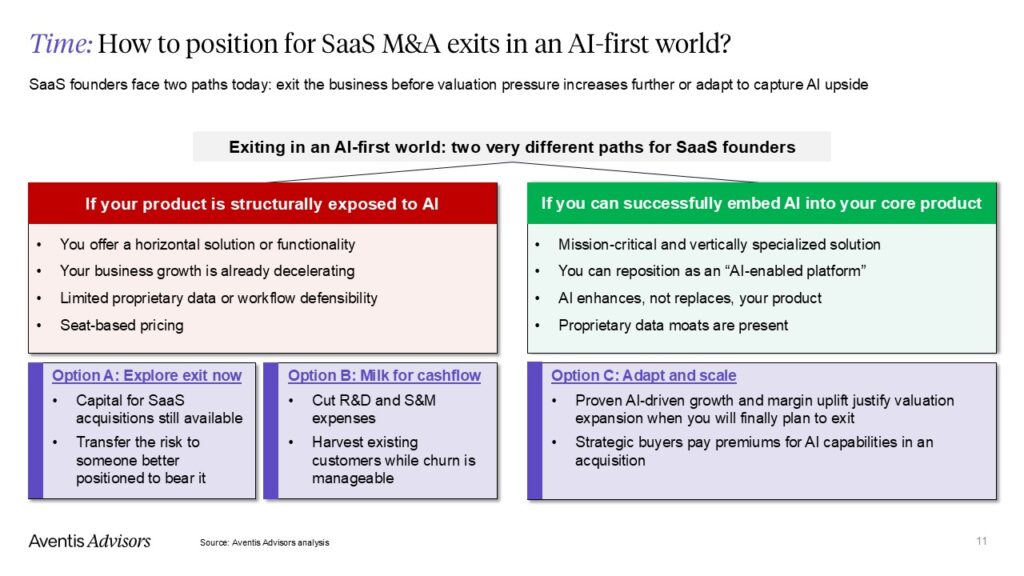
If your analysis reveals significant AI exposure, a low score on the risk dimensions, you need to make a decision quickly. There are essentially two options.
The first is to sell while the business still holds meaningful value, and let a new owner take on the work of transforming it with AI. The second, which is viable for many companies, is to reduce R&D spend and harvest the remaining value in the business. Many companies, particularly those with on-premise or niche vertical software, have more runway than they might think, simply because customers have other priorities and inertia works in your favor. These companies won’t be disrupted overnight.
If, on the other hand, you want to play the AI game and build for the future, we believe that continuing and scaling is the winning strategy, though exiting or optimizing for cash flow also remain valid choices. The world is waiting for companies that genuinely understand how to use AI and are willing to reinvent themselves to serve clients in new ways.
Every company needs an AI story, and every company needs to build real AI capabilities. For those that succeed, we expect meaningful growth. That is really what we can conclude with.
Thank you for your attention today. We hope this has been useful. If you’re interested in exploring M&A options or simply want to talk through how your business can continue to thrive in this new reality, we’d be happy to connect. You can reach us through our contact form, on LinkedIn, or by email. Good luck with your adaptation journey.
Filip Drazdou:
Thank you. Bye!
Marcin Majewski:
Thank you, bye!